When someone asks a chatbot a question, translates a text or uploads photos to the cloud, the processing does not take place on their mobile phone. It takes place on servers, inside buildings known as data centres (data centres). Three such projects are currently being built or are in the process of being licensed in the Spata Municipal Unit: one by Microsoft in Voulia–Prokalisi, one by Data In Scale, a joint venture between PPC and DAMAC, and the 80 MW ‘Olive’ project. Artificial intelligence is the main reason why such buildings are springing up all over the world. Below, we explain what they are, what their licences state regarding electricity, water and generators, and what has not yet been disclosed.
Why artificial intelligence needs buildings like these
A data centre consists of rooms full of servers, along with everything needed to keep them running 24 hours a day: connection to the mains supply, cooling systems and backup generators for power cuts. Artificial intelligence models run on specialised processors that consume far more electricity than a standard server and generate correspondingly more heat, so they also require more cooling.
The figures are provided by the International Energy Agency (IEA) in its 2025 report ‘Energy and AI’. In 2024, data centres consumed approximately 415 terawatt-hours, accounting for around 1.5 per cent of the world’s total electricity consumption. By 2030, their consumption is forecast to more than double, to 945 terawatt-hours, and the IEA states that artificial intelligence is the main reason for this. By way of comparison, according to the IEA, a typical data centre specialising in artificial intelligence consumes as much electricity as 100,000 households.
However, not every data centre is an ‘artificial intelligence centre’. Most also host everyday cloud services, such as email, files, and banking and business systems. Of Spata’s three projects, only Olive has been reported to be explicitly aimed at artificial intelligence applications.
The three projects
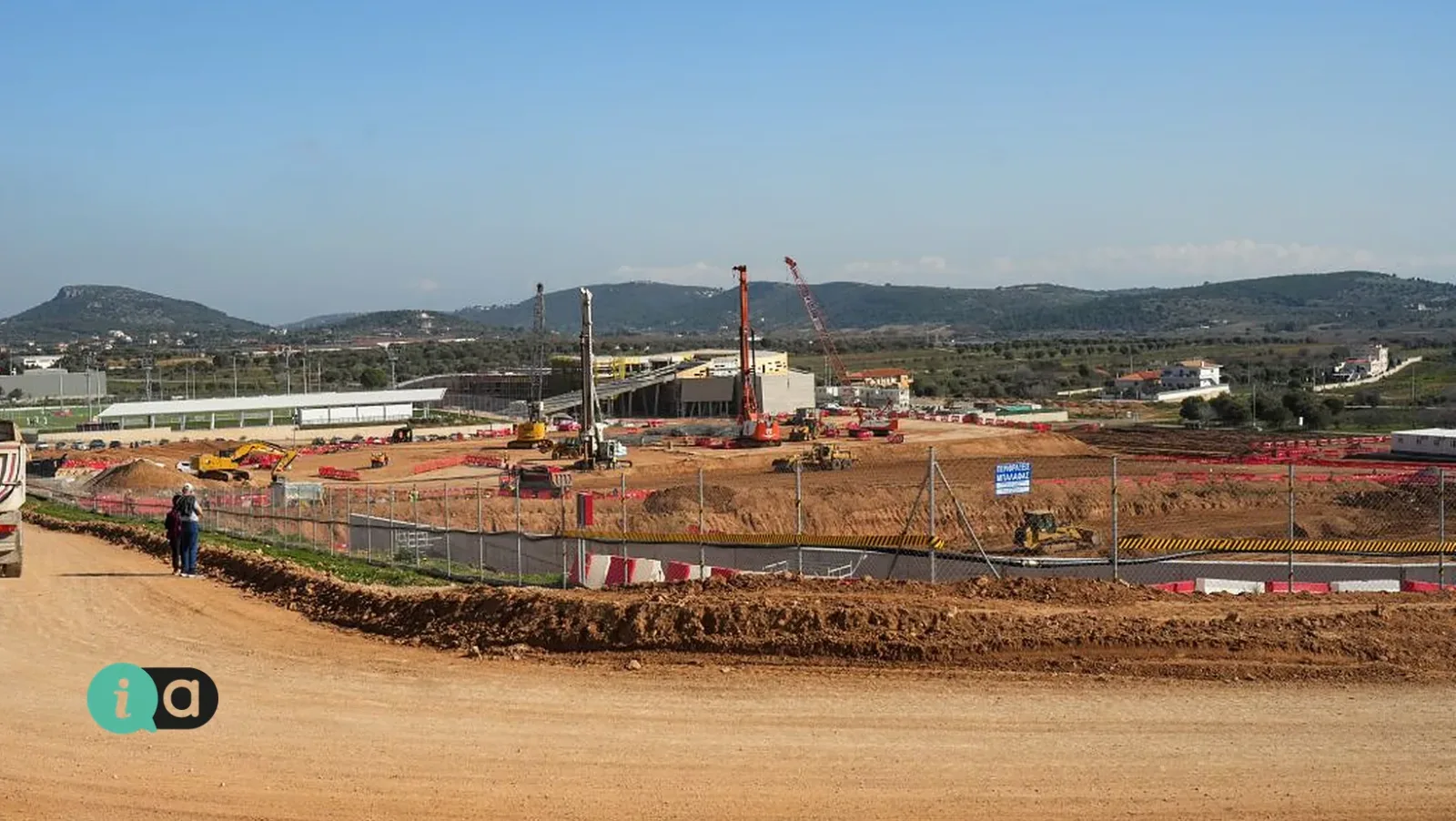
Microsoft. Microsoft’s data centre is being built on plot E31, in the Voulia–Prokalisi area of the business park, on a 69,539 m² site. According to the planning permission, it is a single-storey building covering 10,790 square metres with 50 parking spaces. The third amendment to the planning permission, relating to minor changes to the medium-voltage substation, was issued on 21 September by the General Directorate for Strategic Investments of the Ministry of Development. Microsoft announced its first cloud ‘region’ in Greece in October 2020. According to a report in Naftemporiki in January 2025, the investment plan envisages three data centres in Attica, with a budget of €976 million excluding VAT. According to the same report, the Spata centre has a capacity of 19.2 MW and the aim was for the cloud facility to become operational in early 2028. The company itself has not announced a launch date or which services it will host.
Data In Scale (PPC–DAMAC). Data In Scale is a joint venture between EDGNEX, the data centre arm of the DAMAC Group based in Dubai, which holds a 55 per cent stake, and PPC, which holds a 45 per cent stake. The venture was announced on 4 December 2024 and is building a data centre opposite Smart Park, with an initial capacity of 12.5 MW and an investment of 150 million euros, with the potential to expand to 25 MW. The announcement referred to demand for cloud infrastructure, not artificial intelligence. Two applications for annulment filed by 37 residents are pending before the Council of State, and the company has intervened in one of them, as we reported on 20 October.
Olive. The largest of the three is being developed by Dromeus Capital and Apto, a data centre company founded by the US firm PIMCO, through Greco Mi Real Estate Investments. According to the decision approving the environmental terms issued by the Decentralised Administration of Attica on 19 January 2026, the project comprises two two-storey buildings on two plots totalling 62,499 square metres, with a maximum power demand of up to 80 MW from a 150 kV substation. The rooftops are to accommodate 40 chillers and 14 air-handling units, whilst the ground level will house 40 backup generators with a diesel tank. RE+D magazine, which presented Apto’s programme in December 2025, describes it as a project for large enterprises, for so-called ‘hyperscalers’ – that is, very large cloud providers – and for cloud and artificial intelligence applications. The City Council had unanimously rejected the environmental impact assessment twice, mainly on the grounds of noise, and on 14 September the second preliminary planning permission.
Electricity, water and generators
As regards water, the most specific figures have been published by Microsoft in its factsheet on data centres in Greece dated October 2025. The centre will be cooled using direct water evaporation and, according to the company, will use water for cooling for less than 15 per cent of the time: on days when the temperature exceeds 29.4 degrees Celsius. It purchases the water, as stated, from the municipalities of Kropia and Spata–Artemida. It passes through the cooling system two to five times; some of it evaporates and the rest ends up at the sewage treatment plant. In other words, demand on the grid will fall on the hottest days of summer. Regarding the backup generators, Microsoft states that they are designed to run on renewable biofuel.
For Olive, the environmental authorisation does not specify water consumption. It stipulates that the developer must reach an agreement with the network operators to ensure that water, sewerage, stormwater drainage and energy supplies are secured once the works are completed. It also stipulates that flood protection measures for the area must be completed before the buildings are finished.
In terms of jobs, Microsoft estimates that there will be over 340 employees at the peak of construction and around 50 per building once the centre is operational, working in 24-hour shifts. We were unable to find any published figures for the other two projects.
What the Council says
On 30 June 2026, the Municipal Council, in its opinion on the new Special Spatial Framework for Industry and the Supply Chain, noted ‘the siting of three data centres within the Spata Municipal Unit’ amongst the cumulative pressures on the area, alongside the airport, the three sewage treatment works, the Attica Zoological Park and the Outlet Village. It called for a specific assessment of the cumulative impacts on the municipalities surrounding the airport. On 8 October, the Municipality allocated 35,836 euros for a study to determine whether the region’s infrastructure can support data centres.
Microsoft has another presence in the city. The same press release mentions digital skills programmes in Spata for 350 people and the Minecraft Education programme for 1,200 pupils in Spata. It is also taking part, alongside Socialinnov, in the free courses ‘Digital Skills 60+’ organised by the municipality.
What we don’t yet know
None of the three projects has publicly stated exactly what will be running on its servers, nor whether artificial intelligence models will be trained or operated there. Microsoft has not announced when the Spata centre will become operational. No information has been published regarding how much water the Olive project will consume, whilst the date of the hearing before the Council of State regarding the PPC–DAMAC project has not yet been made public. Furthermore, the contract for the municipality’s study into whether the infrastructure can cope has not yet been published on the ‘Diafania’ transparency portal. We will follow up when answers become available.
Source: Ministry of Development, 3rd revision of the building permit for the Microsoft data centre, ref. no. 2117185/21-09-2026 (Diafania); Decentralised Administration of Attica, decision approving environmental conditions for ‘Data Centre Olive’, ref. no. 3635/19-01-2026 (Diavgeia); Spata–Artemida Municipal Council, Decision 78/2026 (Diavgeia 6 July 2026); Microsoft, ‘Microsoft data centres in Greece’, October 2025; IEA, ‘Energy and AI’, 2025.
Photograph: Ministry of Development / Ministry of Digital Governance (the Microsoft construction site in Spata, January 2025).